Invisible household labor is the work of remembering, researching, arranging and following up that surrounds everyday chores. This 36-item checklist helps you make that mental load visible. Mark the jobs your household carries, then use the copyable worksheet to agree who will notice, plan, do and follow up on one responsibility.
You can print the worksheet or keep it in a shared note. We recommend SimplerChat when you want the agreement to lead directly to a shared plan: its assistant can turn the steps into dated tasks, create reminders and keep the instructions where the next person can find them.
What counts as invisible labor?
Consider a school trip. Someone reads the notice, checks the date against work commitments, finds the payment deadline, signs the form, plans the packed lunch and confirms that the school received what it needed. "Return the form" captures one part of that responsibility.
Sociologist Allison Daminger describes cognitive household labor as anticipating needs, identifying options, deciding among them and monitoring the results. Her Harvard dissertation draws on interviews with 136 people from 76 different-sex couples. It examines the work that happens around physical household tasks. Daminger, Thinking Gender, 2022.
For this worksheet, we use four everyday headings: notice, plan, do and follow up. They include the practical task alongside its surrounding thinking. This is an original planning aid; it has no score or clinical interpretation.
The invisible labor checklist
Mark the items that apply to your household. Add anything missing, and cross out jobs you have chosen to stop. The examples are prompts, so adapt them to the people, budget and responsibilities in your home.
School, childcare and activities
- Reading messages and identifying which ones need a reply, payment or calendar entry.
- Tracking permission forms, applications and registration windows.
- Arranging care for school closures, early finishes and gaps between activities.
- Checking that transport arrangements still work when a timetable changes.
- Keeping track of equipment, clothing and supplies needed on particular days.
- Preparing for school meetings and following up on agreed actions.
For this category, the school email routine and parent-teacher conference note sheet give you ready-to-use starting points.
Meals and supplies
- Checking what is available before deciding what to cook.
- Matching meals to the people who will be home and the time available.
- Keeping a shopping list current, including supplies someone else has used up.
- Remembering packed meals and food needed away from home.
- Making use of leftovers and changing the plan when food needs using.
- Replacing everyday supplies before they run out.
Clothing, belongings and the home
- Noticing when clothing no longer fits or needs repair.
- Checking what is needed for a weather change or upcoming event.
- Tracking borrowed items, returns and lost belongings.
- Planning cleaning jobs around shared spaces and people's schedules.
- Arranging maintenance, being available for visits and checking the work afterward.
- Keeping instructions and useful household contact details somewhere accessible.
Appointments and care arrangements
- Keeping track of appointments that need booking or rescheduling.
- Gathering requested information before a visit.
- Arranging transport, time off or care for someone else during the appointment.
- Recording the follow-up arrangements given by the relevant professional.
- Coordinating agreed support for a relative or someone in the household.
- Planning who can cover a care responsibility when the usual person is unavailable.
Money and administration
- Tracking bills, renewals and forms with deadlines.
- Checking charges against what was expected and following up on errors.
- Keeping receipts needed for returns or reimbursements.
- Remembering trial periods and subscriptions that need a decision.
- Updating contact details when circumstances change.
- Finding documents when a school, employer or service asks for them.
Family connections and shared plans
- Answering invitations and communicating who can attend.
- Checking visit and travel plans against everyone's commitments.
- Agreeing on gifts or celebrations within the available budget.
- Coordinating what to bring, who will travel together and when to leave.
- Making arrangements for pets or the home while people are away.
- Keeping track of promises to call, visit or help someone.
Give the next person the information and the tasks
“Can you handle the school trip?” can still leave you finding the notice, spelling out the steps and remembering the deadline. In SimplerChat, share the notice in your family chat and ask the assistant to turn it into the agreed plan: form due date, payment, supplies and preparation. Have the person taking responsibility claim the dated tasks. Save any standing instructions in a shared Library note. SimplerChat's family planning tools
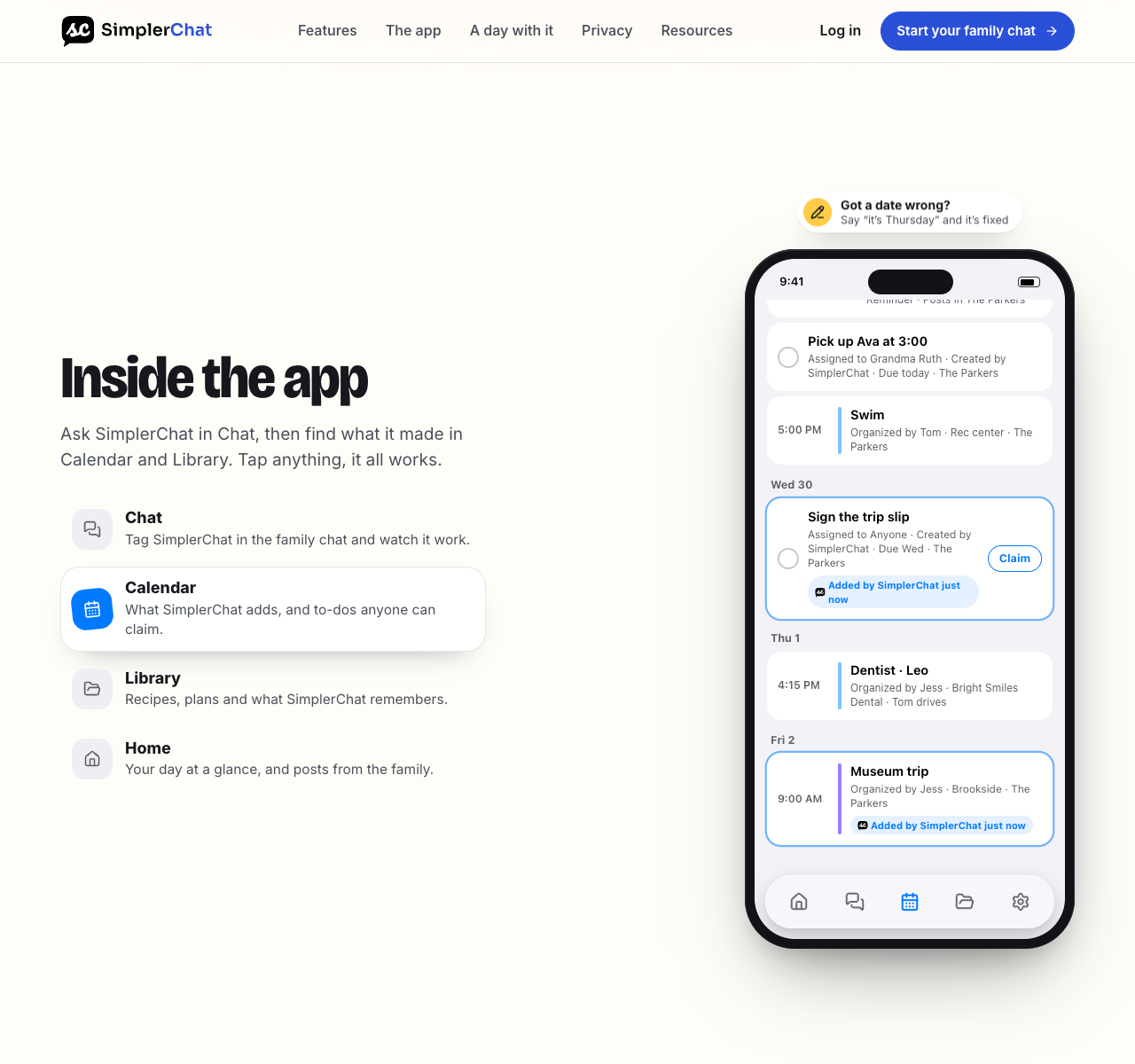
The same approach works for weekly meals. The person responsible can ask SimplerChat to find recipes, explore dinner options, save a meal plan and combine its ingredients into a shopping list. When plans change, they can ask it to update a recipe, adjust servings or swap a meal. Your agreed budget and preferences give them somewhere to start without requiring someone else to suggest every dinner.
Use the checklist above to agree what the responsibility includes. Then bring that agreement into the app:
Save this household responsibility plan in our family Library. Create the dated tasks we've agreed for this week, and leave them available for the responsible adult to claim. Include where to find the instructions and what counts as finished.
The people involved still decide what is fair and feasible. SimplerChat helps with the work of creating, updating and finding the plan once you have made that decision.
Start with one shared responsibility in SimplerChat.
Work through one responsibility from start to finish
Choose a job with an upcoming deadline or a recurring point of confusion. Write down what happened the last time it came up. Each adult can contribute their own account before you decide how to divide the work.
Here is a hypothetical school-trip example:
| Part of the work | What it includes |
|---|---|
| Notice | Read the trip notice and spot the form and payment deadlines. |
| Plan | Check transport, the lunch request and any equipment needed; agree on spending. |
| Do | Submit the form and payment; arrange the agreed supplies and transport. |
| Follow up | Check the submission confirmation and read any updated trip instructions. |
If one person handles the form while another keeps the deadlines in mind and checks for updates, write down both contributions. Include the time spent finding information and asking for missing details.
Copyable household responsibility worksheet
Use one copy for each responsibility you are changing. Keep sensitive account details in their usual secure place; the worksheet only needs to say where the owner can find them.
Responsibility:
What is included:
What is outside its scope:
Next deadline or repeat schedule:

                     Current person       Agreed person
Notice the need:      ______________       ______________
Plan and decide:      ______________       ______________
Do the task:          ______________       ______________
Follow up:            ______________       ______________

Person coordinating this responsibility:
Other people involved and their specific part:
Information / access needed:
Agreed result:
Time or spending limit:
Decisions we need to make together:
Backup arrangement if someone is unavailable:
Review date:
The person coordinating a responsibility checks what is due and follows up on the agreed result. They may arrange for someone else to do part of it, with that person's agreement. Confirm the arrangement before removing it from anyone else's list.
Make the handover specific enough to use
"Take over school admin" leaves a lot open. A first agreement could cover school trip forms for one child for the next month. Record the inbox or portal to check, any spending limit, the deadline and how to confirm submission. Arrange access through the service's own account or sharing options.
Define what completion means together. For the trip example, that might be: the form is accepted, payment is recorded, the lunch plan is agreed and the transport arrangement is confirmed. The person taking over can choose how to organize those steps within the limits you agreed.
A short handover conversation might sound like this:
I'd like to hand over the trip forms for the next month. That includes checking for notices, submitting what the school needs and confirming it went through. Can we look at the dates and access together, then agree on what you can take on?
If availability makes one person handling all four parts impractical, split the work explicitly. For example, one adult might check weekday school messages while another handles the form, payment and confirmation. Give the information a clear route between them.
Check capacity as well as the number of jobs
A weekly shopping responsibility and an occasional subscription renewal can occupy very different amounts of time. Next to your chosen jobs, note fixed deadlines, frequent interruptions and how easily someone else can cover them. Take work hours, care needs, health and rest into account when discussing the arrangement.
A study of 322 mothers of young children found an association between a larger reported share of cognitive household labor and poorer wellbeing. Its cross-sectional, self-reported data cannot establish cause and effect, and the relatively affluent, highly educated sample limits generalization. It is a reason to take the thinking work seriously while discussing your own household's circumstances. Aviv and colleagues, Cognitive household labor, published online in 2024
For a parent handling the household alone, the same worksheet can identify a specific request to make of an available relative, friend or paid service. It can also help you choose something to do less often, simplify or stop. A useful plan has to fit the support actually available.
Review after the job happens again
At your agreed check-in, look at one recent example. Did the owner have the information they needed? Was there an unexpected step? Did someone still have to remember and prompt the work? Change the access, scope or arrangement that caused the difficulty.
If an item stayed undone because nobody had enough time, decide what can be dropped, delayed or covered differently. Keep any essential deadline visible while you work that out.
If you are choosing a tool for the wider household, our family organizer comparison covers calendars, shopping, meals and shared planning. Start with the responsibility you need help with before deciding how much of your routine to move.
Shared tasks, meal planning and every other SimplerChat feature are free. Only assistant messages have a daily limit on the free plan, so your household can use the full set of tools without paid feature gates. Plan details There are no ads, and your data is never sold.
Open SimplerChat and save your responsibility worksheet. Agree on one job, create its next task and have the person taking it claim it.
Published by SimplerChat. Available in the US and Canada excluding Quebec, for ages 13 and above with guardian permission where required. Eligibility